
US guide
How to check your paycheck when you work shifts
Most people start with the deposit and get lost. Start with the hours instead. That's where a shift worker's pay usually comes up short.

ShiftWallet The iPhone app that works out what every shift should pay.


On this page
Put your own record of each shift next to the hours on your pay stub, for exactly the dates the stub covers. If the hours agree, price them with your base rate, differentials and overtime and compare the result with the gross pay line. Leave the net for last, because most of the gap between gross and take-home is withholding.
In four steps
- Find the dates. Your stub prints the pay period it covers. Use those dates, not the day the money arrived.
- Count the hours, week by week. Overtime is counted per workweek, so a two-week check is really two separate checks.
- Price them. Base rate times hours, plus any differentials, plus the overtime premium.
- Then go from gross to net. Taxes and deductions come last.
- Pay period. One workweek here. If you're paid every two weeks, split the stub into its two workweeks, because overtime is counted per workweek.
- Regular hours. The first 40 hours of the workweek at your base rate.
- Overtime. Hours over 40 at 1.5 times the base. On its own that's only right in a week with no differentials.
- Differentials. Night and weekend extras. Under the FLSA they go into your regular rate, so they raise what overtime should pay.
- Regular rate adjustment. The extra overtime owed because the differentials count. Names vary from one payroll to the next, and some employers pay it on a later check.
- Gross pay. The total before taxes. Compare it with your own math for the week.
- Taxes. Federal income tax, Social Security and Medicare, plus state and local taxes where you have them. They don't tell you if hours are missing.
- Net pay. What lands in your account. Not the number to check your hours against.
Hours first: what a real gap looks like
A guard on r/securityguards posted this:
"They shorted me hours last pay period worked 91 hours last pay period got paid for 88."
Split that gap by week and the three hours are worth more than they look. Say it's a two-week period, workweeks run Sunday to Saturday and the rate is $18.50 an hour:
| Workweek | Your record | Regular | Overtime |
|---|---|---|---|
| Week 1 | 46 h | 40 h | 6 h |
| Week 2 | 45 h | 40 h | 5 h |
| Should be paid | 91 h | 80 h | 11 h |
| Stub shows | 88 h | 80 h | 8 h |
Those three hours aren't worth 3 × $18.50 = $55.50. They come off the top of a week that was already past 40, so each one is an overtime hour at $27.75. Three overtime hours come to $83.25.
Compare shift by shift as well as the total. A missing shift or a break taken off twice is much easier to spot with the date and the times in front of you.
Four false alarms to rule out first
Not every gap is underpayment. On Reddit, a lot of "I'm missing money" posts turn out to be one of these:
| What you see | What it often is | How to tell |
|---|---|---|
| The last shift or two of the period are missing | The pay period cut-off. They'll be on the next check. | Read the period dates printed on the stub. See whether those hours turn up on the next one. |
| A night shift shows fewer hours than you worked | It was split at midnight, part on one day and the rest on the next, sometimes in two different pay periods | Look at the punches for both dates, not just the day you clocked in. |
| The deposit is much lower than hours × rate | Taxes and deductions | Compare the gross line instead. |
| A differential, holiday premium or bonus isn't there | It's paid a check later, or listed on a separate line | Look at the next stub before you assume it's gone. |
The deposit one is the most common. When an Amazon warehouse worker asked why their check looked short, two of the three most upvoted replies said it was taxes:
"Taxes. The math checks out on your gross. Your taxes took the rest"
If the hours never show up on the next check, or your overtime rate is exactly one and a half times base in a week that also had a night differential, you're not looking at a calendar problem.
Then the rates: base, differentials and overtime

Under federal law, non-exempt workers get at least 1.5 times their regular rate for every hour over 40 in a workweek. There's no daily overtime under federal law. Some states add it: California pays 1.5 after 8 hours in a day and double time after 12. A workweek is a fixed block of 168 hours that can start on any day, and two weeks can't be averaged. A 30 hour week followed by a 50 hour week still has 10 hours of overtime in it, even though the two add up to 80.
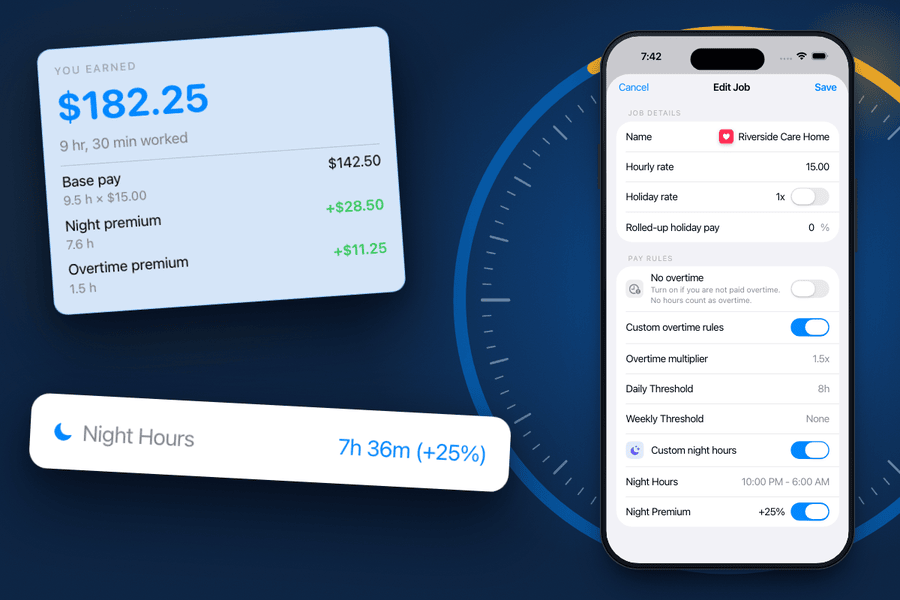
Federal law doesn't require extra pay for nights, weekends or holidays. If you get a differential or a holiday premium, it comes from your employer's policy or your contract, so check what it actually promises before you count it. Once you do get a differential, it goes into your regular rate, which changes what your overtime should be. Night nurses get caught by this one a lot. It has its own guide and a calculator.
Last, gross to net

If the gross matches and the deposit still looks low, the difference is withholding or a deduction you agreed to (insurance, retirement, union dues). The IRS has a Tax Withholding Estimator, linked from its Paycheck Checkup page, if you think too much federal tax is coming out.
If the hours really are missing
Write to payroll. Email, not a phone call, so there's a date on it and you have a copy. Something like:

Hi [name], I think my check for the pay period [start date] to [end date] is short. My own record shows 91 hours, 46 in the first week and 45 in the second, and the stub shows 88. The gap looks like it's in the week of [date]. Could you send me my time punches for that week so I can compare them with mine? Thanks, [your name]
Keep copies of every stub, your schedule, your own record and any screenshots of your punches. A server on r/Serverlife does it like this:
"I put it in my notes app so when check hits I can glance and make sure the numbers match. More than a few times my work messed up so I like to double check their math lol"
Know what your employer has to keep. For every non-exempt employee, the employer must record the hours worked each day and each week, plus straight-time and overtime earnings. Payroll records have to be kept for at least three years and time cards for two, according to the Labor Department's recordkeeping fact sheet. If your numbers and theirs differ, theirs exist and you can ask for them.

If it isn't fixed, you can file a complaint with the Wage and Hour Division on 1-866-487-9243 or through your local office. It's free and confidential, whether or not you have papers. The law also bars your employer from retaliating against you for complaining. You can generally recover two years of back pay, three if the violation was willful.
In a union, the grievance deadline may be days rather than years. Grievances can also pay more than the shortfall:
"Shorted me $126 and with a grievance turned it into $1200 lol easy money"
Where the app comes in

I built ShiftWallet for steps 2 and 3. You log each shift as it happens, or afterwards, and it prices it with your rules. With the US settings it pays time and a half after 40 hours, on your regular rate with differentials included, and the week runs Sunday to Saturday. A 10% night premium between 11pm and 7am is a free switch. A different night window, or a flat differential in dollars per hour, needs Pro.
When the check arrives you type in the gross for that period and ShiftWallet compares it with what your logged shifts add up to. A gap of 1% or less, or $1 or less, counts as a match. The first full check is free and Pro makes it unlimited. Type in only your take-home pay and you get a comparison with an estimate, never an underpaid verdict, since a net figure can't prove one. Since version 2.4 the check also knows your pay calendar (cut-off dates, and differentials that land a check late) and tells you what could explain a difference before you raise it. You can mark shifts as paid, too, and see what you're still owed.
There are a few things it will miss, and you should know them before you trust a match. That Sunday to Saturday week can't be changed, so if your employer's workweek starts on a Wednesday, overtime can land on a different shift in the app. And the Pro tax estimate covers federal tax for a single filer plus FICA, from 2024 tables, and leaves out state and local tax.
Questions people ask
How do I check if my paycheck is right when I work shifts?
Check the hours first, then the rates, then the taxes. Compare your own record of each shift with the hours on your pay stub for the same pay period dates, multiply by your base rate, differentials and overtime, and compare that with the gross pay line. Only look at the net once the gross matches.
How do I verify the hours on my pay stub?
Take your own record of each shift for the exact dates printed on the stub and add up the hours one workweek at a time, because overtime is counted per week. Compare each week's total with the regular and overtime hours on the stub. If they differ, go shift by shift to find the missing day or the break taken off twice, then ask payroll for your time punches for that week.
What should I do if I'm missing hours on my paycheck?
First rule out the usual calendar causes: a shift that falls in the next pay period, or a night shift split across two days. If the hours are still missing, email payroll with your own record and ask for your time punches for that week. If it isn't fixed, you can file a complaint with the Wage and Hour Division on 1-866-487-9243, which is free and confidential.
What evidence do I need for missing wages?
Copies of your pay stubs, your own record of each shift with dates, start and finish times and breaks, your schedule and any emails with payroll. The Wage and Hour Division says pay stubs and your own records of hours worked help. Your employer also has to keep a record of the hours you work each day and each week.
Why is my paycheck short this week?
The usual reasons are hours that landed in the next pay period, a night shift split between two days, taxes and deductions, or a differential paid on a later check. Compare your gross pay with your hours times your rates first. If the gross is right, the difference is withholding or a deduction.
How far back can I recover unpaid wages?
Under the federal Fair Labor Standards Act, generally two years, or three if the violation was willful. The Department of Labor or the employee can sue for the back wages plus an equal amount in liquidated damages. A union contract may set a much shorter deadline for grievances, so check yours.
Sources
- DOL Fact Sheet #21, Recordkeeping Requirements under the FLSA dol.gov
- 29 CFR 516.2, records employers must keep ecfr.gov
- DOL Fact Sheet #23, Overtime Pay Requirements of the FLSA dol.gov
- 29 CFR 778.107, overtime after 40 hours in a workweek ecfr.gov
- 29 CFR 778.105, what a workweek is ecfr.gov
- DOL, night work and differentials dol.gov
- California DIR, overtime FAQ dir.ca.gov
- DOL Wage and Hour Division, how to file a complaint dol.gov
- DOL, back pay dol.gov
- IRS Paycheck Checkup irs.gov
Official sources checked on the date above. If a rule changed after that, the link is the one to trust.
Rather not redo this every payday?
ShiftWallet keeps the record as you work and prices each shift with your rates, so on payday you only type in the gross from your stub. Overtime is worked out on your regular rate, differentials included.
Free to start. Pro is optional.
iPhone and iPad, iOS 17 or later

More from ShiftWallet


