
Calculator for US paychecks
Overtime calculator with shift differential
If you get a night or weekend differential and work past 40 hours, your overtime may be worked out on the wrong rate. Enter one workweek to check.
Overtime with a shift differential, the FLSA way
Updates as you type. It runs in your browser, so nothing you enter is saved or sent anywhere.

Every hour over 40 should pay at least 1.5 times your regular rate, which is your base pay plus differentials for the week divided by the hours you worked. Enter your week and you'll see what it should pay, next to what you'd get if payroll paid overtime at 1.5 × base and added the differential on top.
The same sum, by hand
Say your base rate is $25, you worked 48 hours in the workweek, and 12 of those hours were nights with a $4 differential.
| Step | Amount |
|---|---|
| 48 hours at $25 | $1,200.00 |
| Night differential, 12 × $4 | $48.00 |
| Straight-time pay for the week | $1,248.00 |
| Regular rate, $1,248 ÷ 48 hours | $26.00 |
| Overtime premium, 8 hours × $13.00 | $104.00 |
| What the FLSA requires | $1,352.00 |
| Overtime premium at half of base, 8 × $12.50 | $100.00 |
| What you get with overtime at 1.5 × base | $1,348.00 |
The gap is $4.00 a week, or $208 over a year of weeks like that. It grows with the differential and with the overtime. If all 48 hours had been nights at $4 extra, the regular rate would be $29 and the gap $16.00 a week.
Two differentials work too. For a night nurse on $40 an hour with $5 extra on all 48 hours and $3 extra on 12 weekend hours, enter 48 hours at $5 as the differential and put the weekend $36 in "Other premiums that count". The calculator gives $2,379.00 against $2,356.00, a $23.00 gap, which matches the worked example in the guide.
The formula

- Straight-time pay is your base rate times every hour you worked, overtime hours included, plus every differential. A percentage differential is the percentage of your base times the hours it covers, so 10% on $25 is $2.50 an hour.
- Regular rate is straight-time pay divided by the hours you worked (29 CFR 778.109). Shift differentials belong in it under 778.207.
- Overtime hours are the hours over 40 in the workweek.
- What the FLSA requires is straight-time pay plus half the regular rate for each overtime hour.
- The 1.5 × base version is straight-time pay plus half your base for each overtime hour.
- The gap is half of (regular rate minus base) times your overtime hours.
Do it one workweek at a time. If you're paid every two weeks, that's two separate sums, because federal law doesn't let an employer average hours across weeks.
Which part counts for No Tax on Overtime

The One Big Beautiful Bill Act created a federal income tax deduction for qualified overtime compensation for tax years 2025 through 2028. Only the premium the FLSA requires counts, the half in time and a half, and the FLSA works that half out on your regular rate. In the example above, $104 of the week's overtime pay qualifies. That's more than the $100 you'd get from half your base, and far less than the whole $312 paid for the overtime hours.
When the deduction was new, a lot of people assumed their whole overtime check would be tax-free. The PSA that set it straight on r/antiwork passed 2,000 upvotes:
"If your base rate is $20 for example, and you get paid $30 ($20 x 1.5) when you work overtime, its only the overtime premium…"

In that example, the deductible part is the extra $10 an hour. The rest of what the IRS says in its fact sheet, in short:
- The deduction is up to $12,500 per return, or $25,000 on a joint return, and it shrinks once modified AGI passes $150,000 ($300,000 joint).
- You can take it whether you itemize or not, but overtime is still subject to withholding, Social Security and Medicare.
- Overtime paid only because of state law, a contract or a union agreement doesn't count beyond the FLSA minimum. The IRS example: 50 hours at $20 with double time for the 10 overtime hours gives $100 of qualified overtime (10 × $10), not $200.
- From the 2026 tax year, employers report the amount on Form W-2, box 12, code TT. For 2025 they didn't have to, which is why a UPS worker wrote "you are left to calculate it yourself."
- You need a valid Social Security number, and if you're married, a joint return.
This page isn't tax advice. If the number on your W-2 and your own sum don't agree, ask payroll first and a tax preparer second.
What to put in, and what this leaves out
If you got a nondiscretionary bonus that week, it belongs in the regular rate too. Put it in the "Other premiums that count" box and the calculator adds it before dividing.
The calculator only knows the federal weekly rule. Some states add daily overtime (California's rules are the best known), and that can only add to what you're owed, so there the result here is too low. Hospitals on the 8 and 80 system count overtime by the day and over 14 days instead of by the week, which can come out higher or lower than this, so if yours uses it, do the sum over the 14 days. A Saturday, Sunday or holiday premium of at least 1.5 times your normal rate can be left out of the regular rate. Most differentials are much smaller than that, but if yours isn't, keep it out of the boxes and add it to the result yourself. And if you're salaried and exempt from overtime, none of this applies.
The same sum in the app
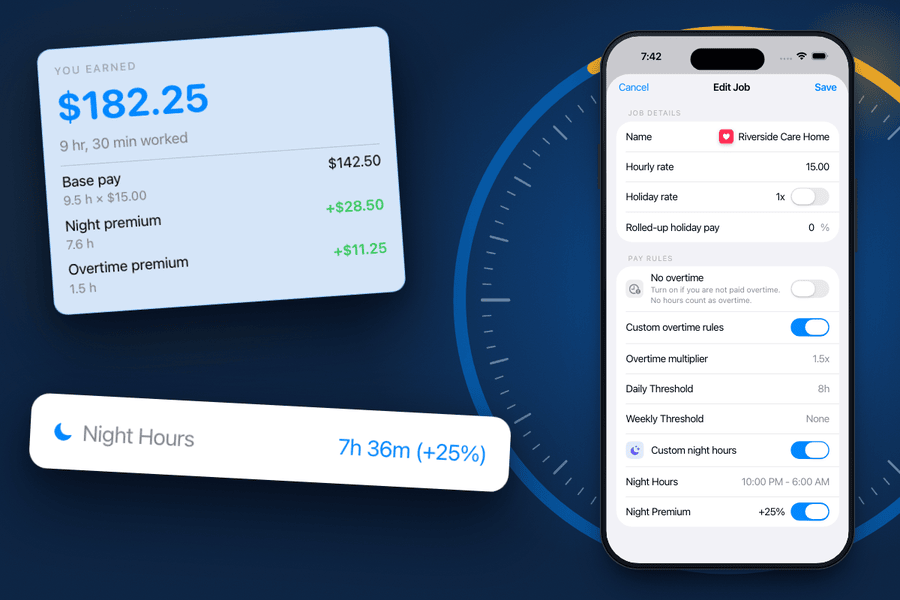
Since version 2.4, ShiftWallet works out US overtime on the regular rate as well, with night and other premiums included, the way this calculator does. If you check a paycheck that paid overtime on your base rate, the second figure above, the app shows it as a mismatch instead of a match. This page is still the quick way to check one week without installing anything. For the rest of a paycheck check, see how to check your paycheck.
Questions people ask
Calculate my overtime if I worked 48 hours with a $4 night differential.
It depends on your base rate and how many hours got the differential. With a $25 base and all 48 hours at night, your straight-time pay is $1,392, your regular rate is $29 and the overtime premium is 8 × $14.50 = $116, so the week should pay $1,508. If payroll used 1.5 × base for overtime, you'd get $1,492, which is $16 less.
What should my overtime rate be with a shift differential?
At least 1.5 times your regular rate, not your base. The regular rate is your base pay for all hours plus all differentials, divided by the hours you worked that week. With a $25 base, 48 hours and $48 of night differential, the regular rate is $26, so each overtime hour should be worth $39 in total.
How much was I underpaid if my employer used my base rate for overtime?
For each workweek, take your regular rate minus your base rate, halve it and multiply by your overtime hours. With a $26 regular rate, a $25 base and 8 overtime hours, the shortfall is $4 for the week. For a night nurse on $40 with a $5 night differential on 48 hours and $3 extra on 12 weekend hours, it's $23 a week. In the calculator, the $36 of weekend differential goes in the Other premiums that count box.
How much of my overtime premium counts for the no tax on overtime deduction?
Only the premium the FLSA requires, which is half your regular rate for each hour over 40 in the workweek. In a 48 hour week with a $26 regular rate that comes to $104. The federal deduction runs for tax years 2025 to 2028, is capped at $12,500 per return ($25,000 joint) and from 2026 employers report the amount on Form W-2, box 12, code TT. This isn't tax advice.
Sources
- DOL Fact Sheet #56A, Overview of the Regular Rate of Pay dol.gov
- 29 CFR 778.207, shift differentials in the regular rate ecfr.gov
- 29 CFR 778.109, how the regular rate is calculated ecfr.gov
- 29 CFR 778.107, overtime after 40 hours ecfr.gov
- 29 CFR 778.105, what a workweek is ecfr.gov
- DOL Fact Sheet #54, health care and the 8 and 80 system dol.gov
- IRS, questions and answers about the deduction for qualified overtime compensation irs.gov
- IRS Fact Sheet FS-2026-13, qualified overtime compensation irs.gov
- California DIR, overtime FAQ dir.ca.gov
Official sources checked on the date above. If a rule changed after that, the link is the one to trust.
The app does this sum too
ShiftWallet logs your shifts and checks your paycheck against them: the hours, base pay, differentials and weekly overtime on the regular rate. A paycheck that pays overtime on your base rate shows up as a mismatch.
Free to start. Pro is optional.
iPhone and iPad, iOS 17 or later

More from ShiftWallet


