
US guide
Is your shift differential in your overtime? How to check
Knowing the rule is the easy part. This guide is about finding it on your own pay stub, with your own numbers.

ShiftWallet The iPhone app that works out what every shift should pay.


On this page
Yes. Under federal law a night, weekend or charge differential goes into your regular rate, and overtime is 1.5 times that regular rate, not 1.5 times your base. If your overtime line is exactly 1.5 × base in a week when you also got a differential, and there's no separate adjustment line, you were probably paid less than the FLSA requires.
A nurse on r/nursing sat down with a year of pay stubs and a copy of the FLSA, then posted what they found:
"Overtime is not time and a half of your base rate."
The rule
Your regular rate is an hourly figure: your total pay for the workweek, minus the few payments the law leaves out, divided by the hours you actually worked that week. The regulation is explicit that night shift differentials go in, as a percentage of your base or as so many cents per hour. The Department of Labor's fact sheet for hospitals says the same thing in plain words: employers must include shift differential pay when working out the regular rate.
What can be left out is a fairly short list. It includes occasional gifts, discretionary bonuses, paid time off, expense reimbursements and premiums for Saturday, Sunday or holiday work that are at least 1.5 times your normal rate. Take a $3 weekend differential on a $40 base: $43 an hour is nowhere near 1.5 times $40, so the $3 counts.
Federal law doesn't make anyone pay a differential in the first place. But once your employer pays one, it's part of the regular rate.
A night nurse's week, worked out
Three 12-hour nights and one extra shift, so 48 hours. Base rate $40. A night differential of $5 an hour on all 48 hours, and one of the shifts falls on a weekend with $3 an hour extra.
| What the FLSA asks for | Amount |
|---|---|
| 48 hours at $40 | $1,920.00 |
| Night differential, 48 × $5 | $240.00 |
| Weekend differential, 12 × $3 | $36.00 |
| Straight-time pay for the week | $2,196.00 |
| Regular rate, $2,196 ÷ 48 hours | $45.75 |
| Overtime premium, 8 × half of $45.75 | $183.00 |
| Total for the week | $2,379.00 |
And here's what a lot of pay stubs show for the same week:
| What many stubs show | Amount |
|---|---|
| Regular, 40 × $40 | $1,600.00 |
| Overtime, 8 × $60 | $480.00 |
| Night differential, 48 × $5 | $240.00 |
| Weekend differential, 12 × $3 | $36.00 |
| Total for the week | $2,356.00 |
The stub comes out $23.00 short. Put another way, with the differentials paid on their own lines like this, the overtime line needed to be $62.88 an hour instead of $60.00, or there needed to be a separate adjustment of $23.00.
Many nurses have never been told this:
"Everywhere I've ever worked you get time and a half on your base wage and then the differentials are added on top"
How to check three paychecks
- Pick three pay stubs from weeks when you worked overtime and also got a differential. If you're paid every two weeks, split each stub into its two workweeks, because overtime is counted per workweek.
- For each week, add up your straight-time pay: your base rate times every hour you worked, overtime hours included, plus every differential.
- Divide that by the hours you worked to get your regular rate for the week.
- Look at the rate on the overtime line. If it's exactly 1.5 × base, take the regular rate minus your base, halve it and multiply by your overtime hours. The result is about what's missing for that week.
- Before you decide anything, look for a separate adjustment line (names vary from one payroll to the next). Some employers pay the difference that way, sometimes on a later check.

That nurse did exactly this, and found:
"My overtime line was exactly 1.5 × base, every period."
If you'd rather not do the division by hand, the overtime and differential calculator takes one workweek at a time.
How much it adds up to

In the example, $23.00 a week. If you have a week like that every other week, it comes to $598 a year. It's small on any single check, so it can go unnoticed for years. One reply in the same thread:
"I have a coworker who years ago figured out she’d been shorted about 65k over the course of her employment, due to an ongoing payroll miscalculation."
Cases that change the sum

- The 8 and 80 system. Hospitals and residential care can use a fixed 14-day period instead of the 40-hour week, if you agreed to it before the work. Overtime is then due after 8 hours in a day and after 80 hours in the 14 days. The differential still goes into the regular rate.
- State law. Federal law is the minimum. Some states add daily overtime on top of the weekly rule, California among them.
- Bonuses. A nondiscretionary bonus goes into the regular rate too. The regulation's own example: $12 an hour for 46 hours is $552 plus a $46 production bonus, $598 in total, so the regular rate is $13 and the week comes to $637.
- Big weekend premiums. If your Saturday, Sunday or holiday rate is at least time and a half, that premium doesn't have to go into the regular rate.
What ShiftWallet does with this

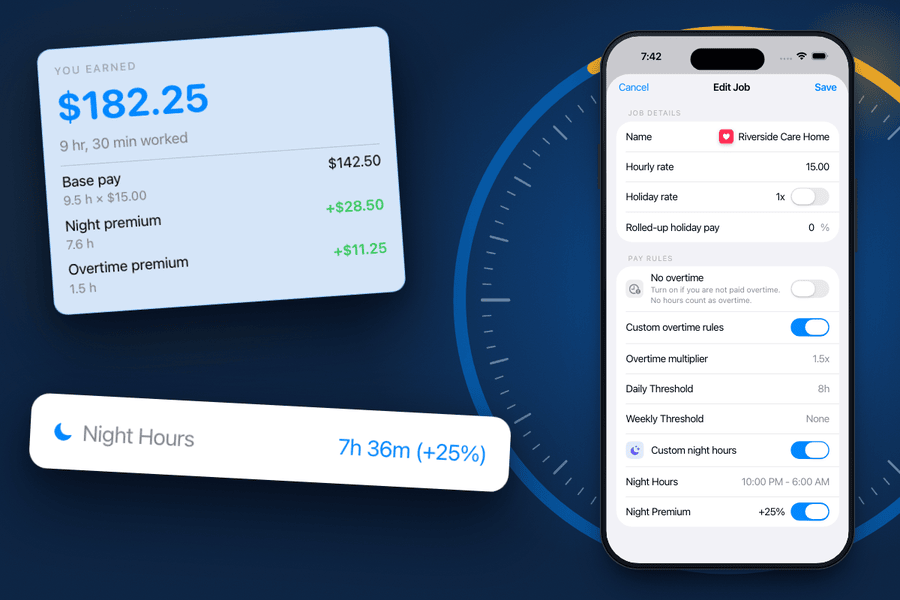
Since version 2.4, ShiftWallet works out US overtime on the regular rate, with night and other premiums included, the way the first table does. Give it the stub from the second table and the paycheck check shows a mismatch rather than a match, because that stub pays overtime on the base rate. With smaller numbers the gap shrinks, to $1.11 in a 45 hour week at $20 with 10 night hours at $2 extra, but it's the same mistake.
To check one week without the app, use the overtime and differential calculator on this site, which works out the regular rate the same way. It runs in your browser.
If your paychecks are wrong
Write to payroll with your three weeks worked out, the way they're laid out above, and ask them to show you how they calculate overtime in a week with differentials. Keep the stubs. If it isn't fixed, the Wage and Hour Division takes complaints on 1-866-487-9243, free and confidential. Back pay can generally go back two years, or three if the violation was willful, plus an equal amount in liquidated damages. For the other checks on a stub, and what to keep, see the paycheck guide.
Questions people ask
Is shift differential included in overtime pay?
Yes. Under the federal Fair Labor Standards Act, a night or other shift differential has to be included in your regular rate, as a percentage of your base or as a set amount per hour. Overtime is then at least 1.5 times that regular rate for every hour over 40 in the workweek, not 1.5 times your base rate.
How do I calculate overtime when I get a night differential?
Add up your straight-time pay for the week, meaning your base rate for every hour plus all your differentials, and divide by the hours you worked to get your regular rate. Then add half the regular rate for each hour over 40. For 48 hours at $25 with 12 night hours at $4 extra, the regular rate is $26 and the week should pay $1,352.
Why is my overtime exactly 1.5 times my base rate?
Because your payroll is using your base rate instead of your regular rate. That's only correct in a week with no differentials or other pay that belongs in the regular rate. If you got a differential that week, your overtime should come out higher, unless your employer pays the difference as a separate adjustment line.
Does night differential count as overtime pay?
No. A night differential is part of your regular rate, which your overtime is then based on, but it isn't overtime pay in itself. Federal law doesn't require employers to pay a night differential at all, but if they do pay one, it has to go into the regular rate.
How do I check my paychecks to see if my overtime includes my differential?
Take three pay stubs from weeks with overtime and a differential. For each workweek, divide your total straight-time pay, base plus differentials, by the hours worked to get the regular rate. If the overtime line is exactly 1.5 times your base and there's no adjustment line, multiply half the difference between regular rate and base by your overtime hours to get roughly what's missing.
Sources
- 29 CFR 778.207, shift differentials in the regular rate ecfr.gov
- 29 CFR 778.109, how the regular rate is calculated ecfr.gov
- 29 CFR 778.110, hourly rate employees and bonuses ecfr.gov
- DOL Fact Sheet #56A, Overview of the Regular Rate of Pay dol.gov
- DOL Fact Sheet #23, Overtime Pay Requirements of the FLSA dol.gov
- DOL Fact Sheet #54, The Health Care Industry and Calculating Overtime Pay dol.gov
- 29 CFR 778.107, overtime after 40 hours ecfr.gov
- DOL, night work and differentials dol.gov
- California DIR, overtime FAQ dir.ca.gov
- DOL Wage and Hour Division, how to file a complaint dol.gov
- DOL, back pay dol.gov
Official sources checked on the date above. If a rule changed after that, the link is the one to trust.
The app does this sum for you
ShiftWallet keeps your hours, prices each night with your differential and works out overtime on the regular rate. If a paycheck pays overtime on your base rate, the check shows a mismatch.
Free to start. Pro is optional.
iPhone and iPad, iOS 17 or later

More from ShiftWallet


